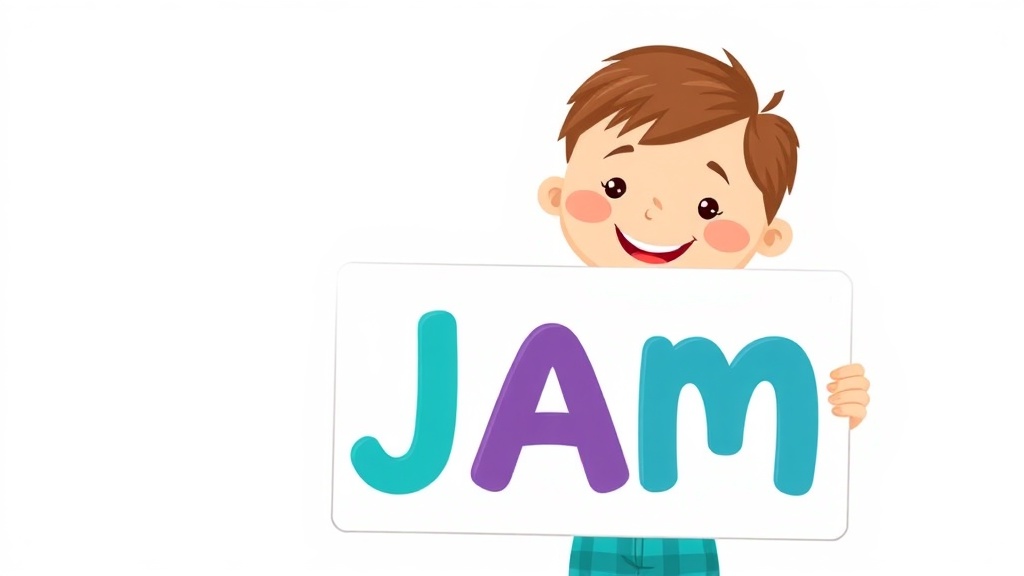
-AM Word Family: Word List and Teaching Activities
What you’ll learn:
- What the -AM word family is and why it’s one of the easiest patterns for early readers
- A sample list of -AM words sorted from simple to more challenging
- Fun, low-prep activities to practice -AM words at home
The -AM word family is a fantastic early phonics pattern — kids already know words like ham, jam, and yam from everyday life, which makes this family feel immediately relevant and fun. Once your child recognizes the -AM ending, they can unlock a whole group of new words just by changing the first sound. It’s one of those satisfying phonics moments where you can actually see the lightbulb go on.
What Is the -AM Word Family?
A word family is a group of words that share the same ending pattern — the same vowel and consonant combination. The -AM word family groups together all words that end in the letters -AM, like ham, jam, clam, and tram.
In phonics, the -AM ending is the rime — the part that stays the same. The letter at the start of the word is the onset. So in the word ram, r is the onset and -am is the rime. Teaching children to chunk words this way — rather than sounding out every single letter — builds reading speed and confidence quickly.
Like most early word family patterns, -AM words are CVC words (consonant-vowel-consonant). The a makes the short /a/ sound — the same sound you hear in cat, map, and bad. If your child already knows the short A sound, -AM words will come naturally.
-AM Word Family Word List
Here’s a sample list of -AM words, grouped from simplest to a little more challenging:
Simple 3-Letter -AM Words
| Word | Use in a sentence |
|---|---|
| ham | We had ham for lunch. |
| jam | She put jam on her toast. |
| ram | The ram ran up the hill. |
| yam | I like to eat yam. |
| dam | The dam held back the water. |
| Sam | Sam ran to the van. |
| Pam | Pam had a red bag. |
4-Letter and Longer -AM Words
| Word | Notes |
|---|---|
| clam | Begins with a consonant blend (cl-) |
| tram | Begins with a consonant blend (tr-) |
| cram | Begins with a consonant blend (cr-) |
| spam | Begins with a consonant blend (sp-) |
| sham | Uses sh- digraph; means something fake |
Tip: Start with the simple 3-letter words and names like Sam and Pam — kids love seeing familiar names in their word lists. Move to blends once the basic pattern is solid.
-AM Words in Simple Sentences
Seeing -AM words in context helps children move from isolated decoding to natural reading. Try these decodable sentences together:
- Sam and Pam sat on the tram.
- The ram had big horns.
- I put jam on my bread.
- The clam was in the sand.
- Dad cut the ham for us.
- We had to cram into the small van.
Have your child point to each -AM word as they read. Better yet, challenge them to come up with their own sentence using an -AM word — it’s great for building confidence.
How to Teach -AM Word Family Words at Home
None of these activities require anything fancy. A few minutes each day is all it takes to make -AM words stick.
1. Sound-Swap Drills
Say /am/ out loud with your child. Then take turns swapping the starting sound: h-am, j-am, r-am, cl-am. This oral exercise builds the phonemic awareness that makes reading easier — and it works just as well in the car or at the dinner table as it does at a desk.
2. Word Family Flip Book
Write am on the right side of a small card. On separate strips, write onset letters: h, j, r, y, d. Let your child flip through the onsets to build new words. The physical act of flipping and reading aloud reinforces both the pattern and the individual sounds.
3. Real-World Word Hunt
Challenge your child to spot -AM words in the real world — on food labels, in books, on signs. Jam is on almost every breakfast table. Ham shows up at the deli. When children find phonics patterns outside of worksheets, it shows them that reading is everywhere.
4. Build a Silly Sentence
Ask your child to use as many -AM words as possible in one sentence. “Sam the ram ate jam on a tram” — ridiculous sentences are memorable ones, and memorable practice is effective practice.
Free -AM Word Family Worksheet
Grab our free -AM word family worksheet (PDF) — it includes tracing, fill-in-the-blank, and a circle-the-word activity, all designed for kindergarten and grade 1. Print and go.
Frequently Asked Questions
What are some -AM word family words for kindergarten?
Great starter -AM words for kindergarteners include ham, jam, ram, yam, and dam. These simple three-letter CVC words are easy to decode once a child knows the short A sound and can recognize the -AM pattern at the end of a word.
How do you teach the -AM word family to beginners?
Start by saying the -AM ending out loud together: /am/. Then swap out the first sound: h-am, j-am, r-am. Do it orally first before moving to flashcards or writing. Once the pattern clicks, kids can decode new -AM words on their own.
What is the difference between word families and phonics?
Phonics covers the full system of letter-sound relationships. Word families are a practical teaching tool within phonics — they group words by a shared ending like -AM so children can decode whole chunks at once rather than sounding out every individual letter.
Keep Exploring
- Letter Sounds — full phonics hub
- -AD Word Family: Word List and Teaching Activities
- -AN Word Family: Word List and Teaching Activities
- Free -AM Word Family Worksheet (PDF)
Do You Even Need to Teach Word Families?
Here’s an interesting thought: you don’t actually need to teach the -AM word family as a group. The -AM ending is really just two sounds — /a/ and /m/ — placed next to each other. If your child already knows that a says /a/ and m says /m/, they can already decode ham, jam, ram, and every other -AM word without the pattern ever being explicitly taught.
Word families are a handy shortcut, but the real foundation is knowing individual letter sounds cold. Once those are locked in, word families aren’t something children need to learn — they’re something children just notice on their own.
This is the core idea behind the Children Learning Reading program. Rather than teaching patterns, families, or sight words by memory, CLR focuses on building solid individual phonemic sounds from the very beginning. It’s a simple, proven method that has helped parents teach children as young as 2 and 3 to read fluently — without flashcards full of word families.
If that approach sounds interesting, take a look at the Children Learning Reading program and see how it works.
Once your child has -AM words down, try the -AD word family or move on to the -AN word family — all three use the same short A sound, so they work great together.
Want a Complete Reading Program?
Our step-by-step program teaches children to read fluently using proven phonics methods.
Learn More →