-OP Word Family: Word List and Teaching Activities
What you’ll learn:
- What the -OP word family is and why it’s a great introduction to the short O sound
- A sample list of -OP words sorted from simple to more challenging
- Fun, easy activities to help your child read and spell -OP words at home
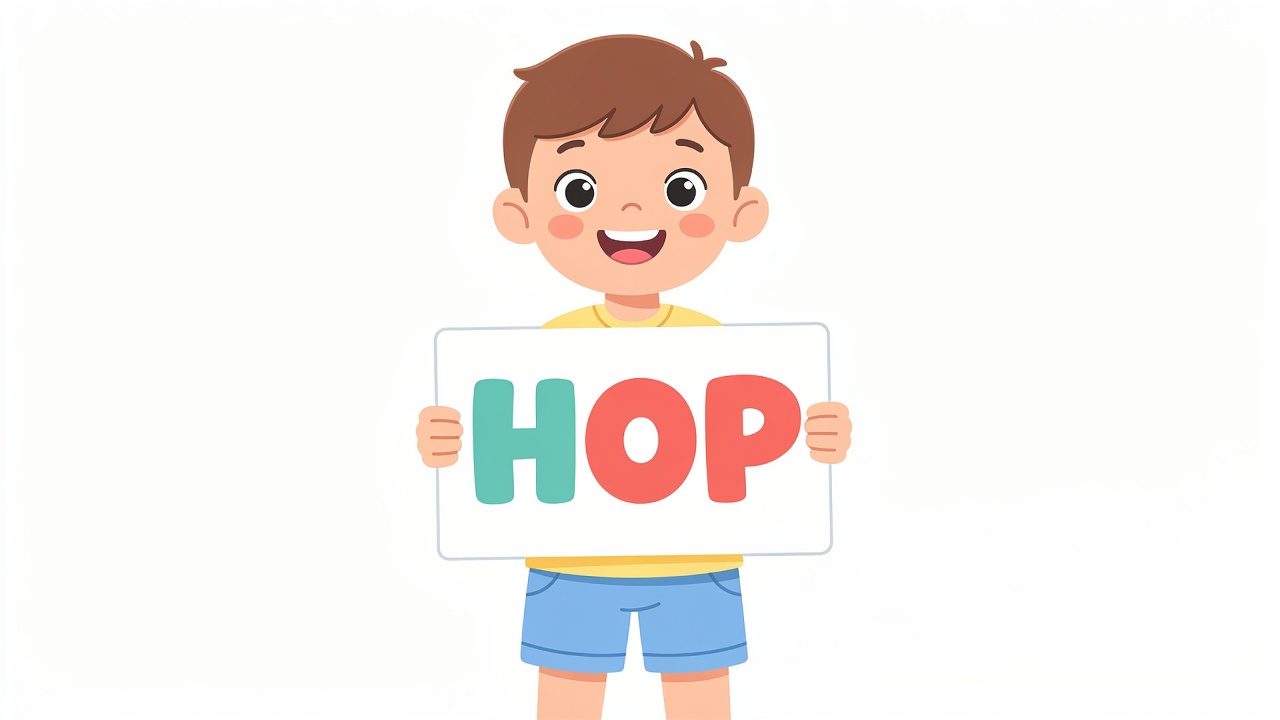
The -OP word family opens up the short O vowel — and it’s a great one to start with. Words like hop, mop, pop, and top are energetic, easy to picture, and loads of fun to act out. After working through short A and short I families, your child now has three distinct vowel sounds in their toolkit. Once the short O clicks into place, a whole new cluster of word families becomes accessible — and -OP is the perfect entry point.
What Is the -OP Word Family?
A word family is a group of words that share the same vowel-consonant ending. The -OP family includes all words ending in -OP, like hop, shop, drop, and prop.
In phonics, the shared ending is the rime and the starting letter or letters are the onset. In top, t is the onset and -op is the rime. Teaching children to read the rime as one automatic chunk — rather than blending three individual sounds — builds the kind of reading speed that makes early books feel manageable and fun.
The key thing to establish before diving into -OP words is the short O sound — the /o/ you hear in octopus, olive, and otter. It’s a rounder, lower sound than short A or short I. Spend a moment contrasting all four vowels your child now knows: /a/... /e/... /i/... /o/... Getting that distinction solid makes -OP words — and all future short O families — much easier to read and spell accurately.
-OP Word Family Word List
Here’s a sample list of -OP words, grouped from simplest to a little more challenging:
Simple 3-Letter -OP Words
| Word | Use in a sentence |
|---|---|
| cop | The cop directed the traffic. |
| hop | The rabbit had to hop over the log. |
| mop | She used a mop to clean the floor. |
| pop | The balloon began to pop. |
| top | He climbed to the top of the hill. |
| bop | She gave the ball a quick bop. |
| lop | He had to lop off the dead branches. |
| sob | She started to sob after she fell. |
4-Letter and Longer -OP Words
| Word | Notes |
|---|---|
| shop | Uses sh- digraph; very common word |
| drop | Begins with a consonant blend (dr-) |
| crop | Begins with a consonant blend (cr-) |
| prop | Begins with a consonant blend (pr-) |
| stop | Begins with a consonant blend (st-) |
Tip: Hop, mop, pop, and top are the four to start with — they’re vivid, fun, and easy to demonstrate. Shop and stop are worth introducing early too since children see both words constantly in the real world.
-OP Words in Simple Sentences
Reading -OP words in context helps your child move from pattern recognition to real, natural reading. Try these decodable sentences together:
- The frog had to hop to the top of the log.
- She used the mop to clean up the drop of paint.
- Don’t let the balloon pop!
- We need to stop at the shop on the way home.
- He had to prop the door open with a stone.
- The farmer checked the crop from the top of the hill.
Sentences 1, 2, and 6 each use two -OP words — a great challenge to spot both before moving on.
How to Teach -OP Word Family Words at Home
Here are four activities that are quick to set up and genuinely effective:
1. Introduce Short O with Contrast
Before starting -OP words, contrast the four vowel sounds your child now knows. Say word pairs across all four vowels: hop / hip / hat / hen. Ask “which one has the /o/ sound?” This is especially important at the short O stage because many children initially confuse short O with short A — they sound surprisingly similar to young ears. A few minutes of contrast work before each -OP session pays off quickly.
2. Onset-Rime Swap
Say /op/ together, then take turns swapping the onset: c-op, h-op, m-op, p-op, t-op. Ask “real word or not?” after each swap. Keep sessions short and brisk — two to three minutes of fast-paced oral practice is more effective than a longer, slower session.
3. Hop to the Word
Write -OP words on pieces of paper and spread them on the floor. Call out a word and have your child hop to it — tying the action of hopping to the word hop makes this particularly satisfying. Swap roles: your child calls a word and you hop to it. This is a brilliant activity for children who find sitting still for reading practice a struggle.
4. Four-Vowel Grand Sort
Mix cards from short A families (-AT, -AP), short E families (-ED, -ET), short I families (-IN, -IT), and -OP words into one big pile. Four piles, one big sort. Children who can sort reliably across all four short vowels have an exceptional phonics foundation — this is a genuinely impressive skill at the kindergarten or grade 1 level.
Free -OP Word Family Worksheet
Download our free -OP word family worksheet (PDF) — it includes tracing, fill-in-the-blank, and a circle-the-word activity for kindergarten and grade 1. Print and go.
Frequently Asked Questions
What are some -OP word family words for kindergarten?
Great starter -OP words for kindergarteners include cop, hop, mop, pop, and top. These simple three-letter CVC words are easy to decode once a child knows the short O sound and can recognize the -OP pattern at the end of a word.
How do you teach the -OP word family to beginners?
Start by saying the -OP ending out loud together: /op/. Then swap the first sound: c-op, h-op, m-op, p-op, t-op. Always begin orally before moving to print. Hearing the short O sound clearly first makes reading and spelling -OP words much more natural for young learners.
What is the difference between word families and phonics?
Phonics is the full system of letter-sound relationships. Word families are a teaching shortcut within phonics — they group words by a shared ending like -OP so children can recognize and decode whole chunks quickly rather than sounding out every individual letter.
Keep Exploring
- Letter Sounds — full phonics hub
- -IT Word Family: Word List and Teaching Activities
- -IN Word Family: Word List and Teaching Activities
- -AT Word Family: Word List and Teaching Activities
- -ET Word Family: Word List and Teaching Activities
- Free -OP Word Family Worksheet (PDF)
Do You Even Need to Teach Word Families?
The -OP ending is just two sounds: /o/ and /p/. A child who knows those individual sounds can already decode hop, mop, pop, and every other -OP word without the pattern ever being introduced as a group. Word families are a handy shortcut — but solid individual letter sounds are what actually power reading.
When a child has truly automatic knowledge of each letter sound, they don’t need to memorize word families — they simply decode words naturally. And that same skill extends to every word they’ll ever encounter, not just the ones in a list. That’s what turns a child who can read familiar patterns into a child who can read anything.
The Children Learning Reading program builds exactly this foundation — teaching each individual phonemic sound systematically and explicitly from day one. Parents have used it to teach children as young as 2 and 3 to read fluently, often well before formal schooling begins.
Learn more about the Children Learning Reading program here and see if it’s the right fit for your family.
-OP is your child’s introduction to short O — a new vowel that opens up a whole new cluster of word families. Try the four-vowel grand sort to consolidate short A, E, I, and O all at once. It’s one of the best activities for building lasting phonics fluency across all the families covered so far.
Want a Complete Reading Program?
Our step-by-step program teaches children to read fluently using proven phonics methods.
Learn More →